Where to Buy Rapamycin (Sirolimus) for Cats with HCM
Rapavie · October 30, 2026
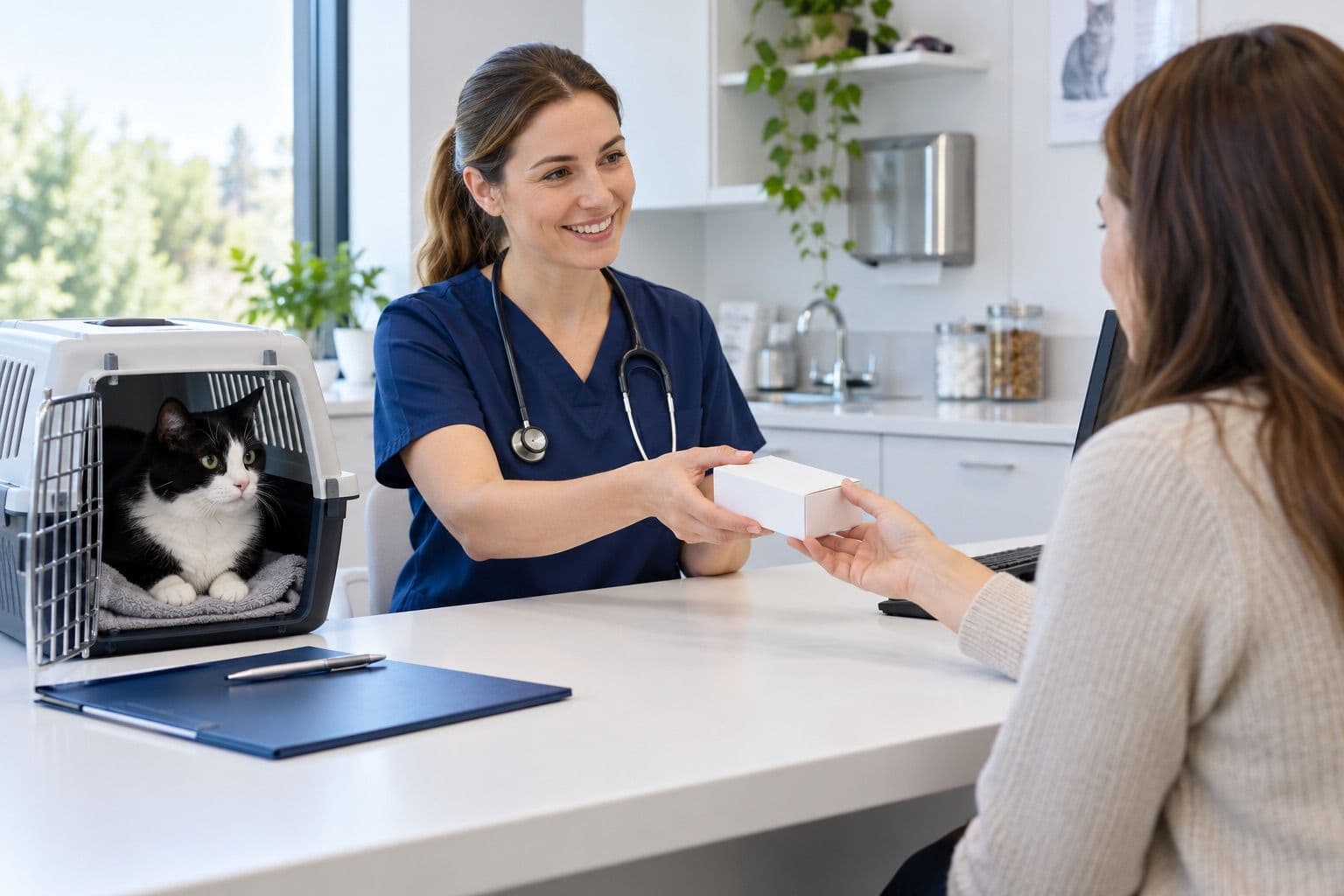
If you want to know where to buy rapamycin for cats, there are two routes. In the US, ask your veterinarian about Felycin-CA1, the conditionally approved sirolimus tablet; in the UK, the EU and most other countries, where Felycin is not available, you can order delayed-release sirolimus tablets online from a shop such as Rapavie and have them shipped to you. Either way it is a prescription medicine for cats with subclinical hypertrophic cardiomyopathy (HCM), and your own veterinarian decides if your cat is a candidate and sets the dose.
| Key facts | | |---|---| | What it is | Rapamycin, also called sirolimus. Rapamune is the human brand | | Used for | Subclinical HCM in cats: a thickened heart wall without heart failure | | Form and dose | Delayed-release tablet once a week with food. RAPACAT and the Felycin-CA1 label use 0.3 mg/kg | | Evidence level | One pilot trial in 43 cats (RAPACAT, 2023). The US approval is conditional, and use elsewhere is investigational | | Felycin-CA1 | US only, conditionally approved 14 Mar 2025. The EU application was withdrawn on 18 Mar 2025 | | Price at Rapavie | From €44 for a 1-month box (0.4 mg), plus €30 tracked shipping per order | | Prescription | Yes. Your veterinarian decides, sets the dose and monitors | | Where to buy | US: Felycin-CA1 through your vet. UK, EU and elsewhere: Rapavie, shipped worldwide |
Are rapamycin, sirolimus and Rapamune the same thing?
Yes, they are one molecule under different names. Sirolimus is the official drug name, rapamycin the one owners know from longevity news, and Rapamune the human brand. Felycin-CA1 is a veterinary brand of sirolimus in a delayed-release tablet. So "buy sirolimus for cats" and "rapamycin for cats with HCM" lead to the same active ingredient; what differs is the formulation, the strength and the regulatory status. There is a longer comparison in our post on sirolimus vs rapamycin.
Can I get Felycin-CA1 in the UK or Europe?
No. Felycin-CA1 is authorised only in the United States, and only conditionally.
The FDA granted conditional approval on 14 March 2025 for "management of ventricular hypertrophy in cats with subclinical hypertrophic cardiomyopathy (HCM)". The target dose is 0.3 mg/kg by mouth once a week, and the tablets come in 0.4, 1.2 and 2.4 mg. Conditional approval is a lower bar than full approval: the sponsor has to show a reasonable expectation that the drug works.
"felycin®-CA1 is conditionally approved for one year from the date of approval and is annually renewable for up to four additional one-year terms." — FDA, Freedom of Information Summary, application 141-604 (FDA)
In Europe the same company, TriviumVet, applied to the European Medicines Agency in April 2023 and withdrew the application on 18 March 2025, while the EMA's veterinary committee still had major objections.
"CVMP considers that the data provided does not allow the Committee to conclude on a positive benefit-risk balance." — EMA/CVMP, Withdrawal assessment report for Sirolimus TriviumVet, 2025 (EMA)
Its concerns included the small sample, whether wall thickness is a meaningful endpoint, and the long-term safety of treating cats that look healthy. We know of no UK authorisation either. So if you searched "felycin-ca1 uk" or "buy rapamycin for cats uk", the short version is that Felycin cannot be bought there, and the option left is delayed-release sirolimus from another source, used under your own vet's guidance.
If you live in the US and your cat has subclinical HCM, Felycin-CA1 is the regulator-reviewed product and the one to ask your vet about first. Our Felycin-CA1 vs compounded rapamycin post covers that choice in more detail.
What did the RAPACAT trial show?
It showed that a low weekly dose of delayed-release rapamycin kept the heart wall from thickening over six months, in a small group of cats.
RAPACAT (Kaplan et al., published in JAVMA in 2023) enrolled 43 client-owned cats with subclinical, non-obstructive HCM. They were randomised to placebo, 0.3 mg/kg or 0.6 mg/kg of delayed-release rapamycin once a week for 180 days. Only the low dose beat placebo.
"...maximum LV myocardial wall thickness at any location, was significantly lower in the low-dose DR rapamycin group compared to placebo (P = .01)." — Kaplan et al., JAVMA, 2023 (PubMed)
In numbers from the FDA summary: maximum wall thickness fell by 0.17 mm in the low-dose group (14 cats), rose by 0.94 mm on placebo (12 cats) and rose by 0.50 mm on the high dose (10 cats). That is why 0.3 mg/kg is the dose everyone uses, and why more is not better.
Two limits are worth knowing. This was a pilot, and the authors call for more studies. And TriviumVet, the Felycin sponsor, funded it. Nobody has yet shown that rapamycin helps cats live longer or avoid heart failure; the trial measured wall thickness. In the FDA file, one low-dose cat developed diabetes, was not treated for it, and died after presenting in diabetic ketoacidosis. That case is part of why the label rules some cats out.
Which cats are not candidates for rapamycin?
Cats with diabetes, liver disease or heart failure are not candidates, and neither are cats with obstructive or advanced HCM.
"...it should not be used in cats with pre-existing liver disease or diabetes mellitus." — FDA CVM Update, 14 March 2025 (FDA)
The FDA file defines subclinical HCM as a left ventricular wall of 6 mm or more, with no high blood pressure, no history of heart failure or blood clots (arterial thromboembolism), and no severe outflow obstruction. If your cat has obstructive HCM, read our post on obstructive vs non-obstructive HCM and talk to your vet about which medicines fit that diagnosis.
Why does delayed-release matter?
Because the only positive trial and the only approval both used a delayed-release tablet, and the 0.3 mg/kg dose was worked out with that formulation.
Rapamune tablets and compounded liquids contain the same molecule, but they are not what RAPACAT tested. A dose that worked as a weekly delayed-release tablet cannot be assumed to behave the same way in another form. That is why Rapavie sells delayed-release tablets, in the same three strengths as Felycin-CA1.
How much does sirolimus for cats cost?
At Rapavie a month of treatment costs €44 to €135 depending on tablet strength, plus €30 shipping per order. In the US, Felycin-CA1 is listed by retailers at $53 to $251 per pack of 12 tablets.
| Strength | 1-month box | 3-month box | |---|---|---| | 0.4 mg | €44 | €119 | | 1.2 mg | €82 | €221 | | 2.4 mg | €135 | €364 |
The 3-month box saves about 10% compared with three single months. To compare with Felycin: on 30 October 2026, Jeffers listed Felycin-CA1 at $53.39 to $251.26 per 12-count pack depending on strength. At one tablet a week, 12 tablets cover 12 weekly doses. For a US owner with a cat that fits the label, Felycin is the approved option and often costs less. Our prices are for owners who cannot buy Felycin.
As for "rapamune cost": we have no reliable prices for the human brand, and it is not the formulation tested in cats.
What dose does my cat need?
Your veterinarian sets the dose. The figure in the trial and on the Felycin label is 0.3 mg/kg once a week, and it explains the three strengths.
A 4 kg cat at 0.3 mg/kg needs 1.2 mg a week, which is one 1.2 mg tablet. An 8 kg cat works out at 2.4 mg, one 2.4 mg tablet. A 5 kg cat comes to 1.5 mg, which falls between strengths, and how to round that is your vet's decision, not ours. Side effects reported in the FDA file were lethargy, vomiting, diarrhoea and loss of appetite. Our rapamycin dosage and side effects post has more detail.
Where to buy rapamycin for cats outside the US
Order delayed-release sirolimus from Rapavie; we ship to the UK, the EU and most other countries.
We sell delayed-release sirolimus tablets in 0.4, 1.2 and 2.4 mg, in 1-month or 3-month boxes, given once a week with food.
How ordering works:
- Agree the plan with your vet. It is a prescription medicine, and your vet should confirm the diagnosis, check bloodwork and set the dose before the first tablet.
- Pick the strength and box size on the rapamycin for cats product page.
- Pay by card through Stripe, in your local currency. There is no subscription; you reorder when you need to.
- We send a tracked parcel. Shipping is €30 flat per order. After dispatch, delivery takes 2–4 days in Europe (including the UK), 1–3 in Türkiye, 3–6 in the Gulf, 4–8 in Asia and North America, and 5–9 in Australia and New Zealand.
We ship to the EU, the UK, Switzerland, Norway, Türkiye, the Gulf states, most of Asia (not China or India), the US, Canada, Australia and New Zealand. A damaged or wrong box is replaced or refunded. In the EU and UK you can return an unopened box within 14 days. With the 3-month box, the €30 shipping is paid once per quarter rather than every month. Questions? Contact us.
What bloodwork and monitoring does a cat on rapamycin need?
Your vet should check blood sugar and liver values before the first dose and keep an eye on both, and repeat the heart scan to see whether the wall is still thickening.
Diabetes and liver disease are the two conditions the FDA names, so the baseline blood test should rule them out. Questions to take to your vet:
- Is my cat's HCM subclinical and non-obstructive, and what was the maximum wall thickness?
- Do the blood glucose and liver values allow rapamycin?
- When should we repeat bloodwork and the echocardiogram?
- What should I do if my cat stops eating, vomits or becomes lethargic?
Frequently asked questions
Can I buy rapamycin for cats without a prescription?
It is a prescription medicine, and it should be used under the guidance of your own veterinarian. Your vet needs to confirm the diagnosis and check bloodwork before the first dose, because some cats should not take it.
Is Rapavie's rapamycin the same as Felycin-CA1?
Both are delayed-release sirolimus tablets in 0.4, 1.2 and 2.4 mg, but they are different products. Felycin-CA1 is the one with US conditional approval. Ours is sold for owners outside the US whose vet wants to use sirolimus, and that use is investigational.
Does rapamycin cure HCM in cats?
No. RAPACAT showed that the heart wall stopped thickening over 180 days in a small group of cats. It did not show longer survival or fewer cases of heart failure, and larger studies are still needed.
Do you ship rapamycin for cats to the UK?
Yes. Delivery to the UK usually takes 2–4 days after dispatch, by tracked parcel, for €30 flat per order. You pay by card in your local currency.
Can a cat with heart failure take rapamycin?
It was not studied in those cats, and Felycin-CA1 is not indicated for them. The EMA also noted signs that it might push some cats into heart failure, so ask your vet or cardiologist about other options.
Sources
- Kaplan JL, Rivas VN, Walker AL, et al. (2023). Delayed-release rapamycin halts progression of left ventricular hypertrophy in subclinical feline hypertrophic cardiomyopathy: results of the RAPACAT trial. J Am Vet Med Assoc 261(11):1628-1637. PubMed
- FDA Center for Veterinary Medicine (2025). FDA conditionally approves drug for management of ventricular hypertrophy in cats. CVM Update, 14 March 2025. FDA
- FDA (2025). Corrected Freedom of Information Summary, application 141-604, Felycin-CA1. FDA
- EMA Committee for Veterinary Medicinal Products (2025). Withdrawal assessment report for Sirolimus TriviumVet (EMEA/V/C/006230/0000), EMA/108424/2025. EMA
Frequently asked questions
Can I buy rapamycin for my cat without a vet?
No. Rapamycin, also called sirolimus, is a prescription-only medicine. Use it only under the guidance of your own veterinarian, who can confirm your cat is a suitable candidate, and treat a site that tells you no vet is needed as one to avoid.
How much does rapamycin for cats cost?
Usually €70–€100 a month, because the dose is set by body weight and cats are small. Every strength is listed on our pricing page.
Is there an FDA-approved rapamycin for cats?
Yes, for one specific diagnosis. Felycin-CA1 (sirolimus delayed-release tablets) received conditional FDA approval in March 2025 for managing ventricular hypertrophy in cats with subclinical HCM. It is available in the US. Conditional approval means a reasonable expectation of effectiveness, not the substantial evidence full approval requires.
What dose of rapamycin do cats get?
Research protocols in cats use about 0.3 mg/kg once weekly, which is also the dose of the conditionally approved feline product. Confirm your cat’s exact strength with your own veterinarian before starting.
Reading about it is the first step. Knowing where your cat stands is the second.
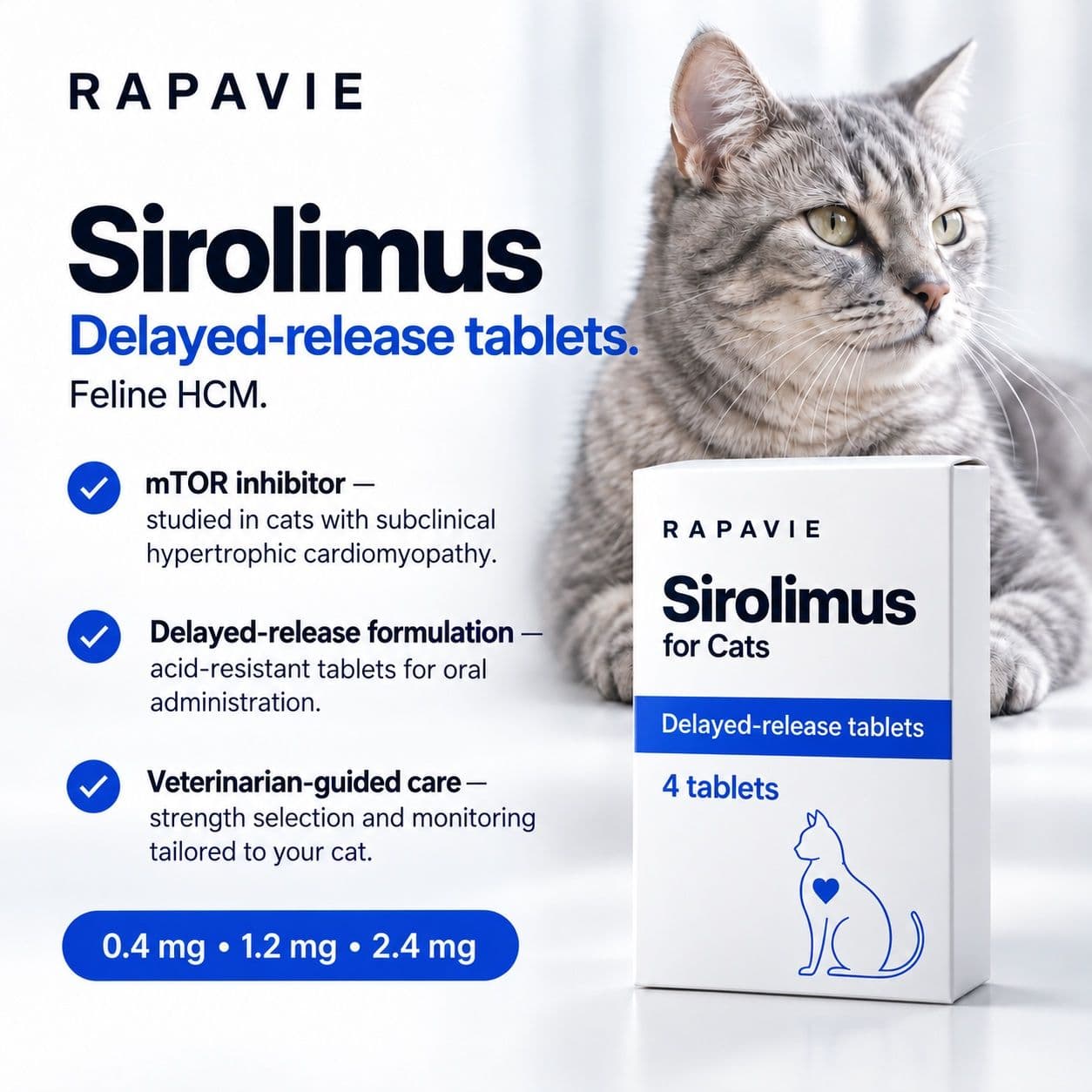
Sirolimus delayed-release tablets
For cats diagnosed with HCM. One tablet a week — 0.4, 1.2 or 2.4 mg by body weight.
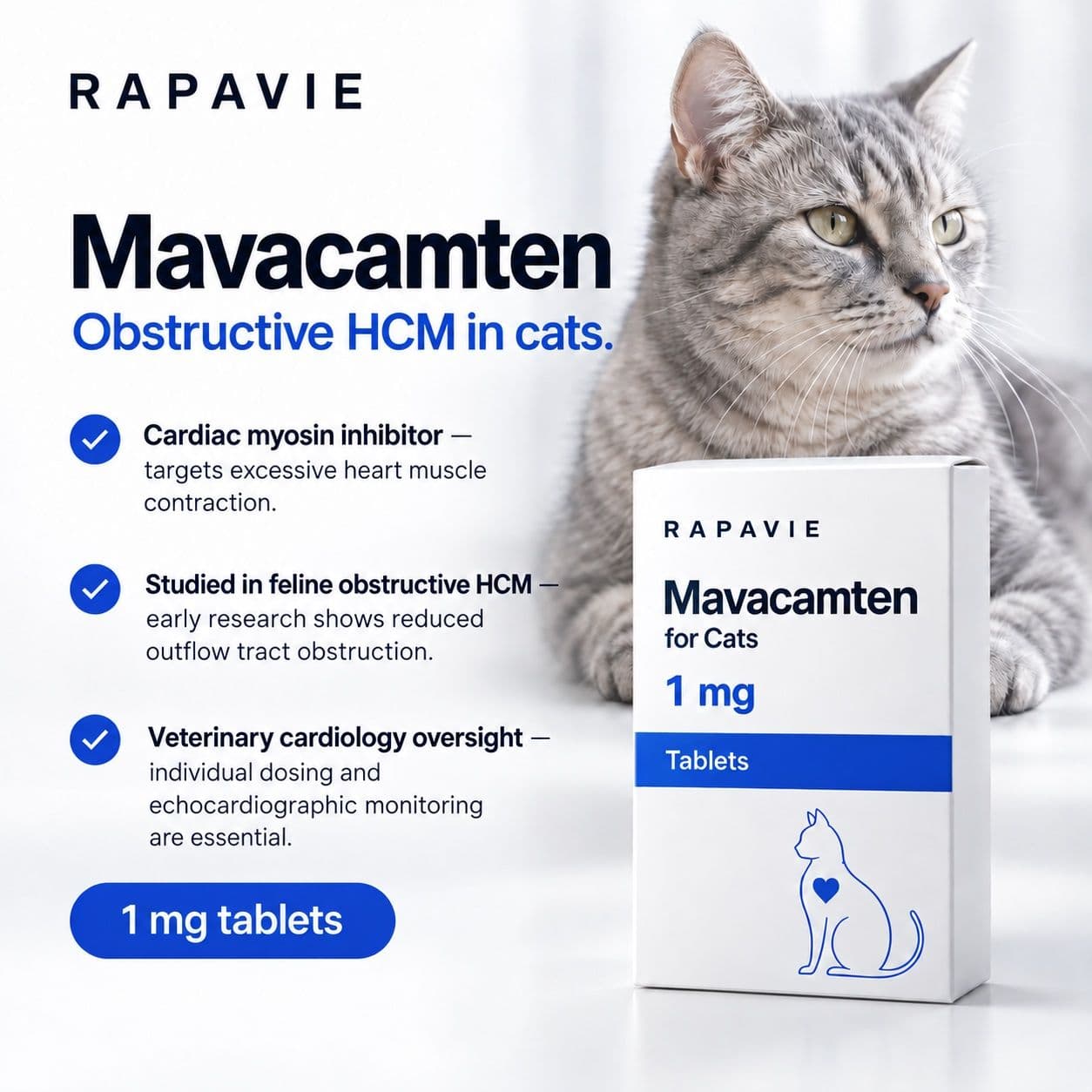
Mavacamten tablets
For cats with obstructive HCM confirmed by echocardiography. 1 mg tablets, once daily.
Rapamycin is a prescription medicine. Use it only under the guidance of your own veterinarian.