Where to Buy Rapamycin (Sirolimus) for Dogs: Price and Dose
Rapavie · October 30, 2026
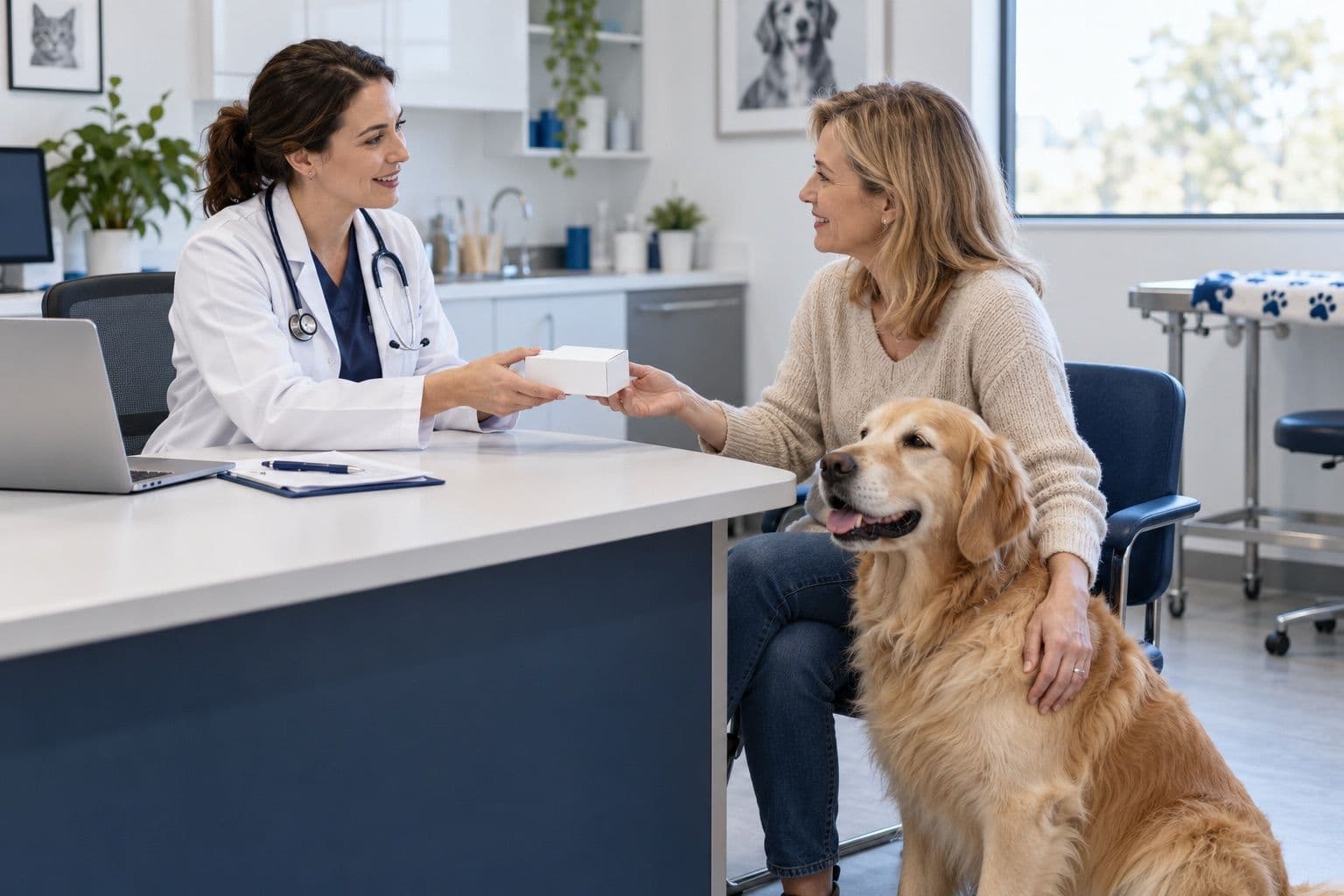
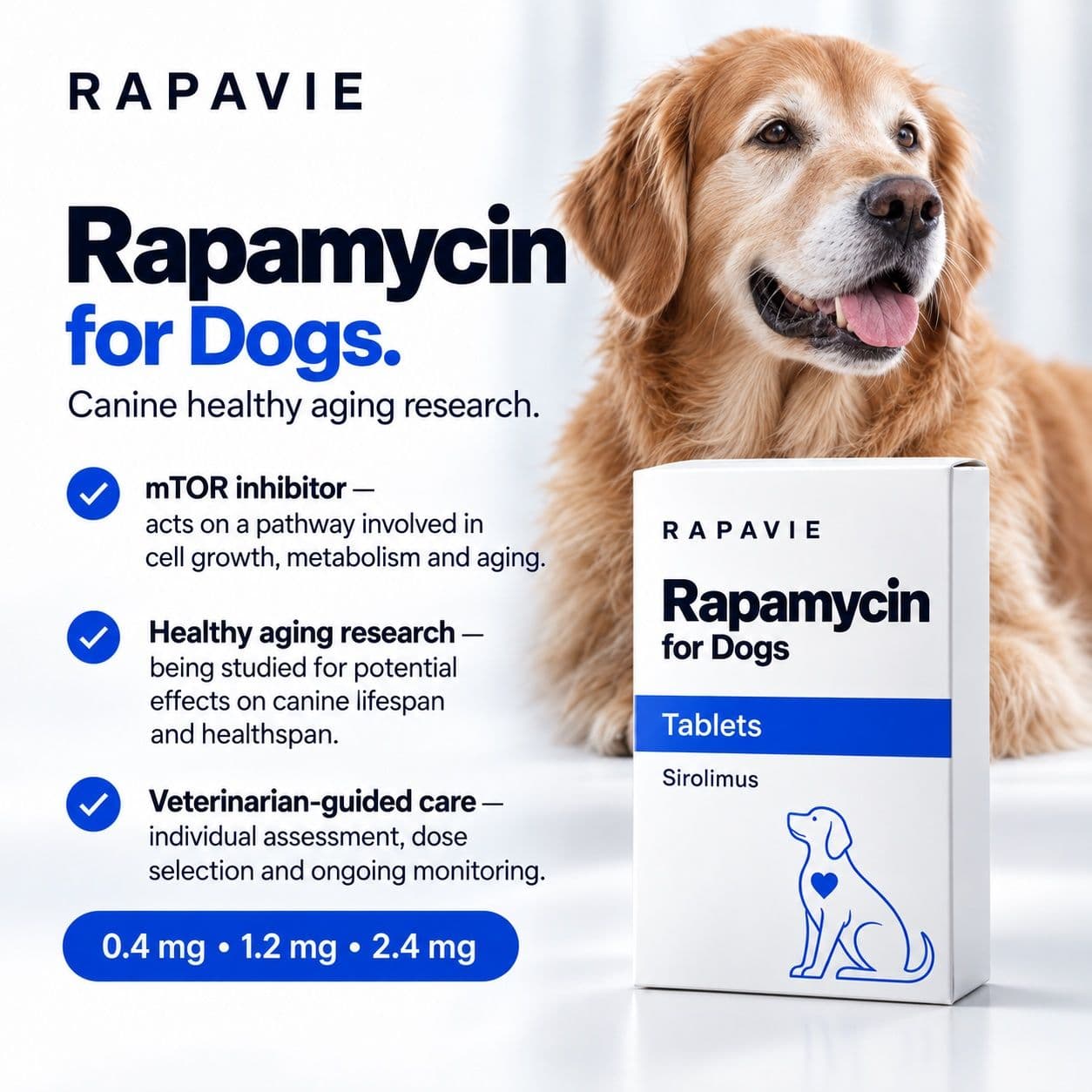
You can buy rapamycin for dogs (the generic name is sirolimus) from Rapavie as once-weekly tablets in seven strengths, from €109 for a one-month box plus €30 tracked shipping worldwide. It is a prescription medicine and is not approved for dogs; owners give it as part of healthy-aging research, so your own veterinarian should choose the dose and run the bloodwork before the first tablet.
| Key facts | | |---|---| | What it is | Rapamycin, also called sirolimus. Rapamune is the human brand | | What owners use it for | Healthy aging in middle-aged dogs. This is research, not a treatment for a disease | | Form and dose | Tablets given once a week; the strength depends on body weight | | Evidence level | Two small trials (24 and 17 dogs) with mixed cardiac results; the large TRIAD trial has not reported | | Price | €109 to €279 per one-month box, plus €30 shipping per order | | Prescription | Yes. Your own veterinarian decides if your dog should take it, sets the dose and monitors | | Where to buy | Rapavie rapamycin for dogs, shipped worldwide with tracking |
What are owners buying rapamycin for dogs for?
Owners who ask us about rapamycin want more healthy years for a dog that is well today. That is the question the Dog Aging Project is testing, and it is still a question. The project describes itself as a long-term study of ageing in tens of thousands of companion dogs (Creevy, Nature, 2022). Nobody has shown that rapamycin makes a dog live longer.
So be clear about what you are buying: a medicine given to healthy middle-aged dogs in two small trials, well tolerated in both, and now being tested for lifespan. It is not a treatment for heart disease, arthritis or cancer. Our longer guide to rapamycin for dogs covers the biology in more depth.
What did the rapamycin dog study results show?
One small trial saw a heart-function improvement, a second small trial did not, and the large trial has published its design but no results.
Urfer 2017. Twenty-four healthy middle-aged dogs received rapamycin or placebo for 10 weeks, at a dose the authors describe as non-immunosuppressive. The heart scans moved in the right direction:
"Echocardiography suggested improvement in both diastolic and systolic age-related measures of heart function (E/A ratio, fractional shortening, and ejection fraction) in the rapamycin-treated dogs." — Urfer et al., GeroScience, 2017 (PubMed)
The authors reported no clinical side effects versus placebo. One blood value, MCV (the average size of red blood cells), fell in treated dogs but stayed inside the normal range.
Barnett 2023. Seventeen healthy client-owned dogs aged 6 to 10 got low-dose rapamycin or placebo three times a week for 6 months. The heart result did not repeat:
"There were no statistically significant differences in echocardiographic parameters between rapamycin and placebo groups at 6 or 12 months." — Barnett et al., Frontiers in Veterinary Science, 2023 (PubMed)
No clinically significant adverse events occurred. Owners of treated dogs reported positive changes more often (26.8% of surveys versus 8.1% on placebo), but that is an owner impression, not a measurement.
TRIAD. The Test of Rapamycin in Aging Dogs could settle the lifespan question. Its design paper came out in 2025:
"...will test the ability of rapamycin to prolong lifespan and improve several healthspan metrics in healthy, middle-aged dogs recruited from Dog Aging Project participants" — Coleman et al., GeroScience, 2025 (PubMed)
In December 2024 the NIH awarded $7 million to expand it. Then, 170 dogs were enrolled across 20 sites; the target is 580. Each dog stays in the trial for three years and is then followed for two more. As of 30 October 2026, PubMed lists no TRIAD outcome paper.
What is the rapamycin dog dose?
The only exact dose in the dog trials we cite is Barnett's: 0.025 mg/kg three times a week. Your veterinarian sets your dog's dose.
For scale, Barnett's schedule in a 30 kg dog works out to 0.75 mg per dose, or 2.25 mg across a week. Urfer's abstract describes its dose only as non-immunosuppressive, and our sources give no TRIAD dose.
Our tablets are given once a week, which is a different schedule from Barnett's three-times-weekly one. Our sources give no once-weekly mg/kg figure for dogs, so we do not print a weight-to-strength chart. Once your vet has chosen a target, multiply it by your dog's weight and match the result to the nearest strength we sell. More in our rapamycin dosage and side effects post.
Is rapamycin safe for dogs?
In the two published trials it was well tolerated, but those trials were short and small, and they enrolled only healthy dogs.
Forty-one dogs, followed for 10 weeks and 6 months, cannot rule out rare or slow-building problems. TRIAD will give the first long-term safety data in pet dogs. See is rapamycin safe for cats and dogs for what has been measured.
Which dogs are not candidates for rapamycin?
Dogs that are already sick were not studied, so they are outside the evidence.
The trials enrolled healthy middle-aged dogs. Barnett's were 6 to 10 years old, and TRIAD only takes dogs that are at least 7 years old and at least 44 pounds (about 20 kg). Talk it through carefully with your vet if your dog:
- has diabetes or liver disease. The only veterinary sirolimus label, Felycin-CA1 for cats in the US, says it should not be used in cats with either, and there is no dog label to say otherwise;
- has a current illness, cancer or a heart diagnosis. Those dogs were not in the trials, and rapamycin was not tested as a treatment;
- is young, or is a small breed. The finished trials used middle-aged dogs, and TRIAD excludes dogs under 44 pounds, so small dogs will not be in its results;
- is due for surgery, or is pregnant or nursing. Ask your vet; nothing in the dog trials covers these dogs.
Where can you buy rapamycin for dogs?
You can buy it from a pharmacy your veterinarian uses, or order it from an online shop such as Rapavie and bring your own veterinarian into the decision before the first dose.
A search for "buy rapamycin for dogs" also turns up lab-grade rapamycin from research-chemical suppliers, sold as powder for laboratory research rather than as an animal medicine.
Why do some online sellers disappear?
In October 2026 the seller that ranked first for "where to buy rapamycin for dogs" had taken its product pages down. Both of its listings now return "410 Gone", the web code a site uses when a page has been removed on purpose. We do not know the reason. A dog may take rapamycin for years, so ask any supplier where they ship and what happens if a box arrives damaged.
What does rapamycin for dogs cost?
At Rapavie a one-month box costs €109 to €279 depending on strength, plus €30 shipping per order. These are our current prices:
| Strength (once weekly) | 1-month box | |---|---| | 0.4 mg | €109 | | 1.2 mg | €129 | | 2.4 mg | €159 | | 3.0 mg | €175 | | 4.0 mg | €199 | | 5.0 mg | €225 | | 8.0 mg | €279 |
Bigger dogs need higher strengths. A dog on the 2.4 mg strength costs €159 a month plus shipping; because shipping is a flat €30 per order, two boxes in one order bring the shipping cost per month down to €15. Budget for vet visits and bloodwork too.
How does ordering from Rapavie work?
You choose a strength, pay by card, and a tracked parcel is on its way.
- Agree the strength with your vet. Bring the studies listed below.
- Pick the strength on the product page. Every strength from 0.4 to 8.0 mg is on the rapamycin for dogs product page.
- Pay by card through Stripe. Checkout shows the price in your local currency. There is no subscription; you reorder when you need to.
- Track the parcel. Shipping is €30 flat per order, worldwide, with tracking.
Delivery times after dispatch:
| Region | Delivery | |---|---| | Europe | 2–4 days | | Türkiye | 1–3 days | | Gulf states | 3–6 days | | Asia and North America | 4–8 days | | Australia and New Zealand | 5–9 days |
We ship to the EU, UK, Switzerland, Norway, the US, Canada and most of Asia (not China or India), plus the regions above. If a box arrives damaged or wrong, we replace or refund it. In the EU and UK you can return an unopened box within 14 days. For anything else, contact us.
What monitoring and bloodwork does a dog on rapamycin need?
Your vet decides the schedule, but expect baseline bloodwork before the first dose and repeat checks while your dog takes it.
Urfer saw MCV drop in treated dogs, still within normal limits, so a complete blood count before and during treatment makes sense. Questions to ask your vet:
- Which blood tests do you want before we start, and when do we repeat them?
- Should we do a heart scan first, given that the dog studies measured heart function?
- What mg/kg target do you want, and which of the seven strengths matches it?
- What signs at home should make us pause the tablets and call you?
- After six months, how will we decide to continue or stop?
Frequently asked questions
Do I need a prescription for rapamycin for dogs?
Yes. It is a prescription medicine, used under the guidance of your own veterinarian, who should be in the loop before the first dose to check your dog, set the dose and plan bloodwork.
What is the difference between sirolimus and rapamycin?
There is none in the molecule. Sirolimus is the official drug name and rapamycin the research name. Our sirolimus vs rapamycin post explains the naming.
Rapamune vs rapamycin: are they the same?
Rapamune is the human brand of sirolimus, which is rapamycin. The active ingredient is the same; the product and tablet strengths differ.
Can my dog join the TRIAD trial instead?
Possibly, if your dog qualifies. TRIAD only takes dogs at least 7 years old and at least 44 pounds, enrolled through the Dog Aging Project, and the study pays for the drug or placebo and the examinations. The Tufts site lists it as recruiting; check the Dog Aging Project for current openings.
Does rapamycin make dogs live longer?
That is not known. TRIAD was designed to answer it, and it has not published results. The two finished trials measured heart function and safety over weeks to months, not lifespan.
Sources
- Urfer SR, Kaeberlein TL, Mailheau S, et al. (2017). "A randomized controlled trial to establish effects of short-term rapamycin treatment in 24 middle-aged companion dogs." GeroScience 39(2):117-127. PubMed
- Barnett BG, Wesselowski SR, Gordon SG, et al. (2023). "A masked, placebo-controlled, randomized clinical trial evaluating safety and the effect on cardiac function of low-dose rapamycin in 17 healthy client-owned dogs." Frontiers in Veterinary Science 10:1168711. PubMed
- Creevy KE, Akey JM, Kaeberlein M, Promislow DEL; Dog Aging Project Consortium (2022). "An open science study of ageing in companion dogs." Nature 602(7895):51-57. PubMed
- Coleman AE, Creevy KE, Anderson R, et al. (2025). "Test of Rapamycin in Aging Dogs (TRIAD): study design and rationale for a prospective, parallel-group, double-masked, randomized, placebo-controlled, multicenter trial of rapamycin in healthy middle-aged dogs from the Dog Aging Project." GeroScience 47(3):2851-2877. PubMed
- Texas A&M (9 Dec 2024). NIH award for TRIAD, press release. vetmed.tamu.edu
- US FDA CVM (14 Mar 2025). Conditional approval of Felycin-CA1 for cats. fda.gov
Frequently asked questions
Can I buy rapamycin for my dog without going through a vet?
No. Rapamycin is a prescription-only medicine. Use it only under the guidance of your own veterinarian, who can confirm your dog is a suitable candidate. A site that tells you no vet is needed is one to avoid.
How much does rapamycin for dogs cost?
Usually in the region of €100–€130 a month, because the dose is set by body weight and larger dogs need a higher strength. Every strength is listed on our pricing page.
Can I use my own vet?
Yes, and you should. Rapamycin is a prescription medicine, so use it only under the guidance of your own veterinarian. Share the protocol and dosing rationale with them so everyone is working from the same information.
Is rapamycin proven to make dogs live longer?
Not yet. It extends healthy lifespan in laboratory mammals and is being studied in companion dogs through the NIH-funded TRIAD trial, which has not reported its primary results. Its effect on canine lifespan is under investigation, not established.
Reading about it is the first step. Knowing where your dog stands is the second.
Rapamycin is a prescription medicine. Use it only under the guidance of your own veterinarian.